

































In May, Oklahoma Gov. Kevin Stitt signed Senate Bill 139, a year-long ban that requires all public schools in the state to enforce stricter policies regarding the use of personal electronic devices during school hours; thus preventing students from using their cell phones, tablets, smart watches and wireless headphones.
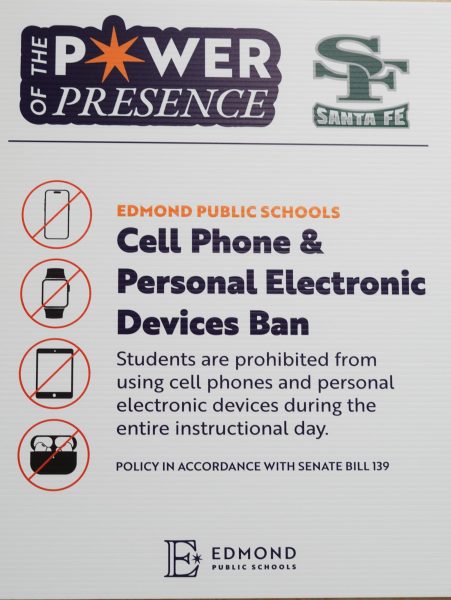
Following the initial enactment of Senate Bill 139, Edmond Public Schools announced “The Power of Presence” initiative: a district wide policy following the new state’s law, which went into effect on the first day of school.
According to Santa Fe Assistant Principal Christy Nieves, there are on average 32 violations of the policy daily, the number increasing after weekends or when everyone is coming back to routine.
“We seem to have more violations on Mondays, or coming back from Labor Day we had 38,” Nieves said.
The policy has been in effect for three weeks now, and teachers have managed to enforce the law, noticing its impact on their teaching environment.
“Students are more tuned in to school,” math teacher Vanessa Palmer said. “It will be more difficult for students to cheat on their assignments in class, which will challenge them to learn more.”
Like many other teachers, Kaitlin Powers, a psychology teacher at Santa Fe, already had a no phone policy during instructional time, but now, because of the enforcement of a state level policy, she notices more compliance from students.
“Instead of having it be a battle now and then, it is more constant that everyone knows to keep their phones away,” Powers said.
Educators like science teacher Colt Nickel have taught internationally, in places where phones were already banned in schools.
“I wasn’t accustomed to phones being such a daily classroom management concern,” Nickel expressed. “Even though it takes a little extra time to manage phones at the start of class, I’ve noticed that once they’re put away, students are less distracted and able to sustain attention for longer periods.”
Nickel has noticed new challenges in his teaching environment from the law, such as students carrying a second phone with them to ignore the law, or having to control the usage of phones during lunch time, where a large group of students is present.
“This makes it harder to manage and can create unnecessary tension,” Nickel said.
Teachers feel more valued by students now that phones aren’t permitted in classrooms. AP Literature teacher and yearbook adviser Stephanie Bray is one of those teachers.
“I don’t feel like I’m being disrespected everyday anymore,” Bray said.
Not only has the new phone policy benefited the learning environment, but it has also improved the social environment at the school, strengthening the community by encouraging students and staff members to socialize more.
“Students are talking to each other in the hallways and greeting their teachers,” U.S. Government teacher Jacqueline Bessinger said.
Teachers aren’t the only ones to notice positive changes; students have seen the impact on their discipline and social life throughout the school day.
“I find myself talking to others more,” senior Emme Shum said. “I’ve never been more social and engaged with everybody.”
However, some students feel as though the lack of phones in school has increased their screen time at home.
“I feel more addicted to it because I haven’t been on it,” senior Chloe Lamprecht said.
An additional complaint from students has been that they cannot listen to new music releases while at school. Popular artists such as Laufey, Dominic Fike, Sombr and Earl Sweatshirt have all come out with albums recently.
“A bunch of artists dropped, but you can’t have your phone, so you can’t listen to them at school,” junior Samuel Sargeant said.
Sargeant disagrees with the law as he believes that it won’t stop students from using their phones and it is each student’s responsibility to care.
“It’s their education; If they don’t wanna learn, that’s on them,” Sargeant said.
Another critical opinion of the law is how it is enforced on upper classmen.
“I don’t believe this law should be enforced strictly for juniors and seniors, as by that age, they should understand that their actions have consequences,” senior Jonathan Alkara expressed.
Being a part of DECA, Alakara mentioned the effect the policy has had on communication for clubs.
“Our teacher would send us reminders on Remind during [the] school day, and now she can’t,” Alakara said.
This has been an issue for many clubs at school as students used apps on their phones such as Groupme, Discord, Remind or text messages to communicate with each other and to receive announcements from their club sponsors.
To adapt to the law, some clubs, including DECA, have found other ways to communicate.
“It made communication with the sales carts a little tricky, but we use walkie talkies now,” Alakara said.
On the other hand, some students noticed the benefits it has in their daily lives. Senior Nevaeha Michelle, who expressed that it has improved her life, making her less addicted to her phone.
“It teaches me that there’s more to life than just my phone,” Michelle said. “I’m slowly gravitating towards not being on my phone as much, even outside of school.”
With time, students’ opinions have switched from negative judgment to positive after seeing the beneficial effects of the law.
“Initially, I was against it because I had been so used to [being] able to use my phone during class,” Shum said. “But after experiencing what school is like without them, I do support it.”
The new phone policy has affected every student and educator in a different way, but with the ban potentially being long term, it will continue to shape school learning environments around the state.